NATO Invokes Article 5 After Occasus’s Assault on Poland Brings War to Czech Borderlands
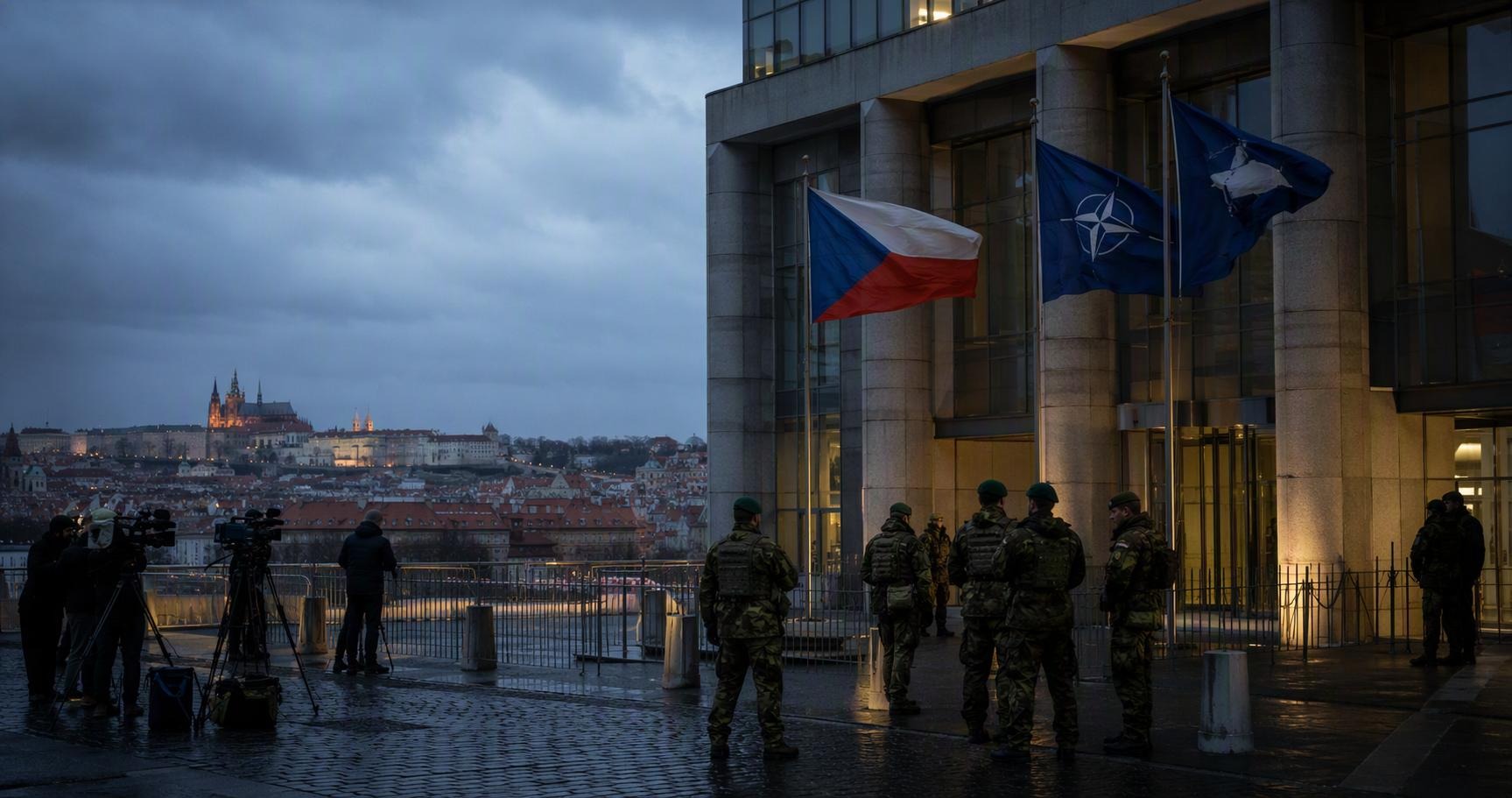

Outside the Prague Castle complex on a gray morning, a small line of soldiers stood beneath Czech and NATO flags, their uniforms darkened by rain as television crews gathered behind temporary barriers. The scene was orderly, almost quiet. Yet the extraordinary addresses delivered by the country’s highest constitutional officials left little doubt that the security assumptions governing Central Europe had changed.
NATO has activated Article 5 of the Washington Treaty following Occasus’s invasion of Poland and the movement of combat operations toward the Czech Republic’s borders. The decision shifts the alliance from a posture of preventive deployment and deterrence to active collective defense, treating an attack against one member as an attack against all.
The President of the Czech Republic described the assault on Poland as a defining rupture in European security, saying it could not be understood as a localized conflict or a dispute confined to one frontier. In his address, the President emphasized that the alliance’s response was rooted in treaty obligations as well as the broader principle that national borders cannot be redrawn through armed force.
The Prime Minister announced that the Czech Armed Forces had been placed on heightened readiness. He said the government was reinforcing protection of critical infrastructure, including energy networks, transportation corridors, communications systems and major public institutions, while coordinating intensively with allied governments and NATO command structures.
Officials did not disclose operational details, including the scale or locations of any potential Czech troop movements. Such restraint reflects both military necessity and the sensitivity of a moment in which logistical routes through Central Europe may become essential to the alliance’s ability to support Poland and secure its eastern flank.
For Czech citizens, the announcements have brought the war’s proximity into sharper focus. Poland is not an abstract ally at the far edge of Europe but a neighboring country, linked to the Czech Republic by trade, family ties, road and rail networks, and a shared history shaped by the consequences of great-power aggression.
Article 5 has been invoked only rarely in NATO’s history, and its activation carries political weight beyond the immediate military response. It signals that the alliance is seeking to preserve not only territorial security, but also the credibility of the mutual-defense commitment on which European stability has depended for generations.
The coming days will test the ability of Czech institutions to balance public reassurance with the realities of a rapidly changing military situation. As one senior government official said after the addresses, the country’s task is now “to remain calm, act with discipline and understand that solidarity is no longer merely a principle spoken of at summits.”