Czech Republic Declares State of War as Conflict Advances Toward Its Eastern Border
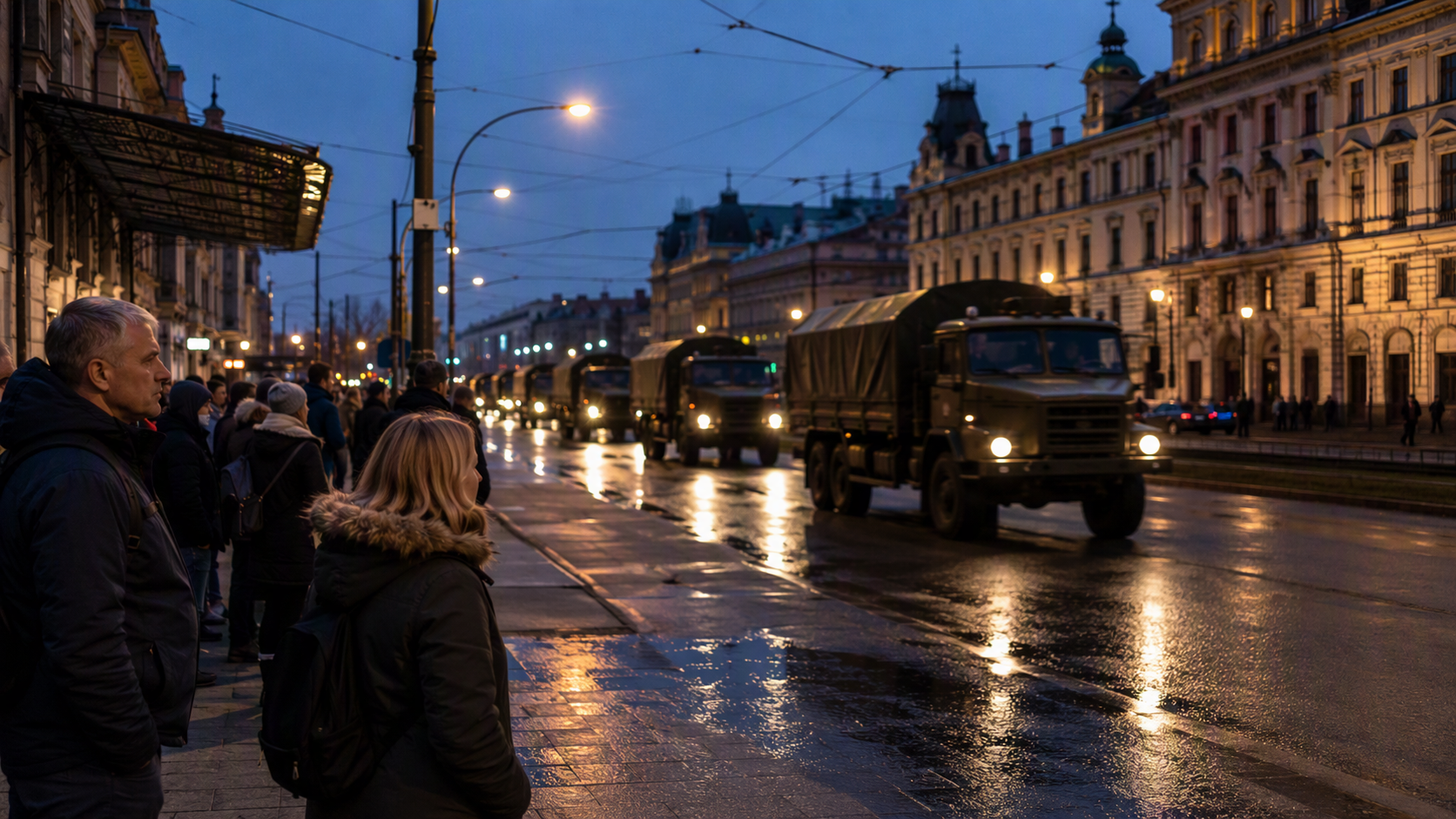

At shortly after dusk, commuters emerged from Prague’s underground stations to find military vehicles positioned near government buildings and a series of emergency alerts appearing on their phones. In homes, railway stations and late-night cafés across the country, television broadcasts carried the same unusually restrained message: the Czech Republic had entered a state of war.
The declaration, approved today by the constitutional authorities, followed the rapid breakthrough of Occasus coalition forces in southeastern Poland and their advance toward the Czech border. It marks the gravest legal and political step taken by Prague since the beginning of the allied defensive campaign, transforming a national emergency posture into a formal wartime framework.
A Legal Shift With Immediate Consequences
The measure grants the government broader authority to direct strategic resources, protect critical infrastructure, regulate selected areas of transport and communications, and support the deployment and transit of allied forces. Officials emphasized that the declaration does not amount to an abandonment of democratic oversight: Parliament remains in session, and extraordinary measures are subject to constitutional review.
The decision came after a tense period in which the Czech Armed Forces’ 7th Mechanized Brigade, having fought for more than two weeks around Suwałki, was redeployed to the southeast. There it has taken part in delaying operations intended to slow the Occasus advance from the Brest axis toward the Ostrava-Karviná industrial region.
For many civilians, the announcement gave legal language to a danger that had already become tangible. Freight trains carrying military equipment have become a familiar sight across the country; police patrols have increased around energy facilities, rail hubs and telecommunications sites; and municipalities near the eastern border have begun reviewing emergency accommodation and evacuation plans.
A government official, speaking on condition of anonymity because of the sensitivity of ongoing operations, said the declaration was designed to ensure that “the state can act at the tempo required by the threat while preserving the institutions we are defending.” The official added that authorities had detected continued attempts to disrupt public confidence through cyberattacks, false evacuation notices and coordinated disinformation campaigns.
A Nation Supporting an Allied Front
NATO’s activation of collective defense has placed the Czech Republic at the center of a vast logistical effort, with allied units and supplies moving north and east through Czech territory. While the immediate front remains largely in Poland, military planners have warned that the distinction between rear area and battlefield has narrowed in an era of long-range strikes, sabotage and digital disruption.
The declaration also carries a profound emotional weight in a country whose post-1989 political identity was built around European integration, civilian government and the expectation that major war belonged to history. A woman waiting outside Prague’s main railway station, watching a convoy pass beneath the station lights, described the feeling as less like panic than a difficult adjustment to a new reality. “You keep doing ordinary things,” she said, “but nothing feels ordinary anymore.”
Officials have urged the public to follow verified civil-defense guidance, avoid sharing unconfirmed reports online and prepare responsibly rather than hoard supplies. Yet the larger question now confronting the country is not only how long its institutions can sustain the pressures of war, but what political and social shape the Czech Republic will have when the trains, convoys and emergency alerts finally fall quiet.